Thursday, May 1, 2014
Friday, April 25, 2014
Life in the Sand
![]() |
| Desert Horned Lizard |
I like to think I’ve learned how to move around animals in non-threatening ways in order to get close. It probably has more to do with the nature of the animal. Does it naturally hold still, blend in and hope it isn’t seen or does it flee as fast and far as possible. Some hold their ground and defend themselves or bluff with an intimidating display. This horned lizard just didn’t seem to care that I laid down in the sand a few feet away and pointed my camera it's way. Maybe it had seen photographers before. It posed nicely in the light for me.
I often tell people I would like to study ants in the field. I’m not sure if I could really do that but I would really like to learn more about them and other social insects. They do some amazing things (and I’m not talking about carrying things that weigh more than they do).
![]() |
| Zebra-Tailed Lizard |
When you’re near the bottom of the food chain it’s good to be hard to see.

Here’s our wasp friend again. Looks like she’s a parasitic wasp.
Just a few more paralyzing stings to get this caterpillar to hold still.
It's hard work to carry the caterpillar to the nest.

In one large depression in the dunes I heard bees. It took me a few minutes but found a bunch of digger bees. About a month ago I watch an episode of “Life in the Undergrowth” that showed how digger bees are victims of parasitic Blister Beetles. Here is a link to that part of the episode.
Life in the Undergrowth - Blister Beetles & Digger Bees
It’s worth watching. It’s a pretty remarkable sequence of events.
I believe the digger bees are responsible for these tracks in my previous post. Were they searching for an existing tunnel that was covered up with the sand or looking for a good place to start a new one? Or something else?
Here’s a video I took of the digger bees. Turn up the sound to hear them buzzing around.
When I was growing up in Southern California I used to plant tomatoes every year so I could attract a similar type of caterpillar. Don’t ever remember eating any homegrown tomatoes. I think the worms completely consumed the plants.
![]() |
Coachwhip (Red Racer)
|
I didn’t get a good picture of this snake. It’s the type of animal that tries to flee (it's called a racer for a reason). It didn’t hold still much and I didn’t pursue it too far. Didn’t want to stress it in the heat of the day. It might need the energy to flee from a real predator or catch a meal.
Another Ichneumonidae (a large family of wasps most of which are parasitoids).
“I cannot persuade myself that a beneficent & omnipotent God would have designedly created the Ichneumonidae with the express intention of their feeding within the living bodies of caterpillars, or that a cat should play with mice.” Charles Darwin -- From a letter to Asa Gray, 22 May 1860
![]() |
| Chuckwallas |
This is where I think I know how to move around animals to get close to them. These Chuckwallas kept their eyes on me but let me get pretty close. It took some patience on my part too.
![]() |
Help! Quicksand!
|
Tuesday, April 22, 2014
Tracks in the Sand
Tracks in the sand record so many stories.
Some are mysterious like what made these and why?


Others are more obvious. A bird. What kind of bird and what was it doing?
Why did this track suddenly stop? Did the critter burrow into the sand. Thinking (or at least hoping) it wasn’t a scorpion, I dug into the sand with my hands to see. I didn’t find anything. Did it dig deeper than I did? Did it tunnel under the sand to a different area? Was this where it came out of the sand and start crawling away?
I’m pretty sure I discovered what made these tracks.
Any ideas?
See my next post for the answer.
Some traces survive many sand storms.
A mouse or rat digging in the sand. Maybe looking for a meal.
Most tracks I see are so interesting and add to the beauty of the dunes. I don’t feel the same way about my own tracks. I feel guilty even though I know they will be gone in a few days.
Some are mysterious like what made these and why?


Others are more obvious. A bird. What kind of bird and what was it doing?
I think a beetle made this.
Not really sure about this one.
Why did this track suddenly stop? Did the critter burrow into the sand. Thinking (or at least hoping) it wasn’t a scorpion, I dug into the sand with my hands to see. I didn’t find anything. Did it dig deeper than I did? Did it tunnel under the sand to a different area? Was this where it came out of the sand and start crawling away?
I’m pretty sure I discovered what made these tracks.
Any ideas?
See my next post for the answer.
Some traces survive many sand storms.
A mouse or rat digging in the sand. Maybe looking for a meal.
Must be a lizard. I can almost see it.
I don’t feel as guilty as I hope the person that left these tracks feels. Driving off established roads is strictly prohibited. At first I was disgusted that some fool would do this. This kind of damage can last many years. I realized that I don’t know the story behind these tracks either. Maybe it was a rescue team saving some crazy photography who got heat stroke.
Although this isn’t a track in the sand it's my favorite kind of track in the desert.
Wednesday, January 1, 2014
Virgin River
At the end of December I went to Zion National Park to get away from the cold and spend some time outside. I went mainly to hike to Observation Point. It was a great hike. I enjoyed it even more than Angels Landing. While I was there I spent a few hours taking long exposure photos along the Virgin River. I was having some technical problems that frustrated me for awhile. I believe the problem was cause be a very cheap wireless remote release that I carry as a backup. The battery went dead in my Nikon wireless remote so I used my cheap backup. I think it was activating twice every time (or most every time) I pressed the button. Not good when trying to take a 60 second exposure by pressing once to start the exposure and a second time to end it. I had a spare battery for the remote too but just grabbed the spare remote instead. Oh well, my intentions were to just practice long exposures anyways. I did learn from the problems I was having and it was fun.
I tried to find places where there was no one else around but I every time I setup my tripod within minutes there would be a dozen other people around trying to get the same shot. That's okay, I like seeing other people enjoying photography too.
Thursday, November 28, 2013
Hitchhiker
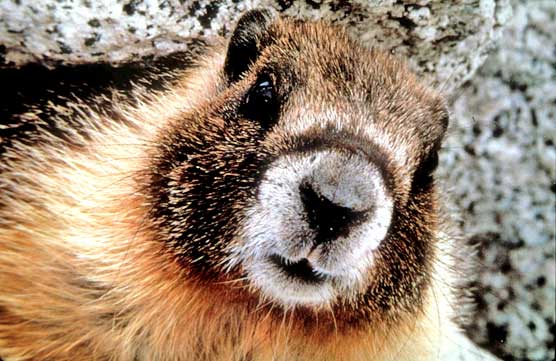
| Marmots are the larges members of the squirrel family and occasional chewers of boot, backpack strap, hiking pole grips, and radiator hoses. |
Something unusual happened a few months ago while I was driving to my parents house after work. I had traveled about 25 miles on the freeway when my brake warning light came on. My car is only a year and a half old so I thought it was odd but probably something minor and didn't worry. A few minutes later the ABS warning light on. Then the brake system and TRAC system warning lights came on. I grew more concerned and a bit upset at the quality of my car. When I got to my exit I found I had virtually no brakes at all. It took pressing the pedal as hard as I could to get a little grip. The exit was long and there were no other cars so I was able to come to a stop safely. I drove slowly a few more miles to my parents house timing it so I didn't have to stop at the lights and coasting to a near stop before using the parking brake to stop completely. I didn't know what the problem was but I figured I could at least check the brake fluid. When I opened the hood, to my surprise there was a marmot sitting on top of the engine. The strangest part was I knew exactly what had happened. A few weeks earlier I was reading (listening actually) to Neil Peart's book "Roadshow: Landscape with Drums" in which he told of seeing cars at Kings Canyon wrapped in plastic to keep the marmots out because they like to chew on hoses and wiring in cars. The marmot jumped off the car, ran underneath it and back up behind the engine. A man driving by stopped in the middle of the road, rolled down his window and yelled "What the hell was that?" I replied "A yellow bellied marmot. It just chewed up my brake line."
I ran to tell my parents to come out and see this. I got a flash light and a stick and tried to poke the marmot thinking it would get out of my car. It just bit onto the stick and played tug-o-war with with me. I then got the hose and a spray nozzle and began blasting it with water. It still would not leave it's hiding spot behind my engine. It was soaked, scared, pretty unhappy and began to chirp. The neighbors came out to see what all the commotion was about. They were snapping pictures and took turns playing tug-o-war with the wet rodent.
I resorted to calling the local animal control officer to come help. The officer said she gets 2 to 3 calls a month for marmots being in peoples cars. She added they usually just run away when confronted and she didn't know what to do about this angry little critter. So she called another officer who was good with animals. When he arrived and looked over the situation he said there was nothing he could do because he didn't think I would want him to pepper spay it or shoot it since it was in my car. He was right. He said leave it alone and maybe it will run off when there was no one around.
I drove the car over to a nearby church parking lot where it was quiet and no one was around. I then borrowed my parents car and got some brake fluid. When I came back I wasn't sure if the marmot was there or not but I thought I would drive back to my parents to survey the damage. As I was leaving the parking lot very slowly I felt a bump. I looked in my rear view mirror and saw a wet marmot shuffling across the parking lot and into some bushes. Even though I was mad at the marmot, I felt bad that I ran it over and hoped it wasn't hurt too bad.
The brake fluid spilled onto the ground as fast as I poured it in. The brake line was split wide open, held together by just a thread. I could see it also chewed up a grounding strap on top of the engine. Fortunately that was all the damage. However, it did cost me $500 to have it towed and repaired and it was in the shop about a week waiting for parts.
I still can't figure out where I picked up this marmot. It certainly was in my car when I left work that day. I don't believe there are marmots living near where I work. Did it get a ride to work in someone else's car then switch rides? Did it get into my car a day or two earlier and ride around with me without causing any trouble? Guess I'll never know. Now every time I hear a strange noise in the car I wonder if there's a marmot under the hood.
Each spring and early summer, the marmots of Mineral King have been known to dine on rare delicacies. Their fare includes radiator hoses and car wiring! Like bears, jays and ground squirrels, marmots have not only become accustomed to visitors, they have learned that people are a source of food.
In the parking areas some marmots feast on car hoses and wires. They can actually disable a vehicle. On several occasions, marmots have not escaped the engine compartment quickly enough and unsuspecting drivers have given them rides to other parts of the parks; several have ridden as far as southern California!
The whole thing sounds ridiculous, but it's true. If you visit Mineral King, especially during the spring, check under you hood before driving away. Let the rangers know whether or not your vehicle has been damaged. And don't forget, marmots also love to feast on boots, backpack straps, and other salty things such as the grips of hiking poles.
Wednesday, November 20, 2013
The Wave
I started hiking early and got to the Wave when it was still in the shadows.
It was nice to watch the morning sun spill over the sandstone.
I was wearing a Buff that said National Geographic on it.
I just got it, mainly to cover up my hair when camping and I can't shower in the morning.
I was asked by a few hikers if I worked for National Geographic. I wish.
There was a group of Chinese students that had a GoPro on a remote controlled... well I'll call it a drone.
They got photos from interesting angles. Too bad there was some guy wearing
It's funny how much I can enjoy laying on my belly in wet sand on a chilly morning
as long as I have my camera in my hands.
A formation called The Second Wave.
A couple from Germany asked me where to find the Big Mac formation.
I have no idea. They said it looks just like a Big Mac.
An strange deviation in the patterns of the Wave.
It's fun to think about the processes that might have form this. The laying down of sediments,
pressures turning it to stone, upheaval of the area, wind and water erosion.
Somewhere in there some kind of geological turbulence bent, cracked and twisted this section.
Leaves floating in a shallow puddle on the way to the Wave.
Tuesday, November 19, 2013
Paria Time Lapse
Subscribe to:
Posts (Atom)